

Fracture Not Healing? Causes, Diagnosis and Treatment in Ahmedabad
Fracture Not Healing? Causes and Treatment in Ahmedabad
Most people expect a broken bone to improve steadily after a cast or surgery. But what if pain remains at the same spot, or your follow-up X-ray does not show the progress you expected? A fracture can sometimes heal more slowly than usual. In other cases, the bone may stop making meaningful progress toward healing.
If you are worried that a fracture is not healing, do not decide from pain or one X-ray alone. An orthopedic surgeon needs to consider the bone involved, the original injury, treatment so far, symptoms and imaging over time. Here is what those terms mean and what an evaluation may involve.
What Does It Mean When a Fracture Is Not Healing?
Delayed union means a fracture is taking longer than expected to heal. Nonunion means the broken ends have not joined and the fracture has failed to heal. These are clinical assessments, not labels you can assign after a fixed number of weeks: different bones and injuries heal at different rates.
For a bone to heal, the fracture needs enough stability, a suitable blood supply and the biological conditions for new bone to form. Your doctor will compare your recovery and repeat images with what is expected for your particular injury.
Signs That a Fracture Needs Another Review
Ongoing pain does not automatically mean nonunion, but it deserves assessment if your recovery seems to have stalled. Reasons to arrange a review include:
- Pain or tenderness that continues at the original fracture site, especially when the limb is used.
- Difficulty using the arm or leg that is not improving as expected.
- A feeling of movement or instability at the old break.
- Follow-up X-rays that show little progress in bone bridging over time.
- New swelling, redness or drainage near a surgical wound or fracture site.
Tell your surgeon if symptoms have changed, and bring your earlier X-rays, scans, discharge summary and operative notes if available. Fever, wound drainage, a newly cold or numb limb, or rapidly worsening pain needs prompt medical evaluation.
Why Can a Broken Bone Heal Slowly?
Stability and injury severity
The broken ends need to remain appropriately aligned and stable. A high-energy accident can also damage the surrounding soft tissue and blood supply. Some fractures are difficult to hold in position even after initial treatment.
Health and healing factors
Tobacco or nicotine use, diabetes, infection, poor nutrition and some medical conditions can interfere with healing. Your medication history also matters. Do not stop a prescribed medicine on your own; discuss any concern with the treating doctor.
The bone and its blood supply
Some bones have a more limited blood supply, and an injury can further disrupt it. This is one reason the same healing timeline cannot be applied to every fracture.
What Treatments Are Available for a Non-Healing Fracture?
The right treatment depends on why the bone has not united, whether there is infection, the stability of the fracture, and your general health.
- Continued protection or immobilization: In selected cases, a brace, splint or cast may provide the support needed while healing is monitored.
- Bone stimulation: A doctor may consider a bone stimulator for certain nonunions. It is not suitable for every fracture.
- Revision fixation: If stability is the main problem, surgery may use a plate, screws, a rod or an external frame to hold the bone appropriately.
- Bone grafting: A surgeon may use a graft or another approved material in selected cases to support new bone formation, often together with stable fixation.
- Infection treatment: If infection is involved, it needs a specific plan. Simply adding a graft or changing an implant may not address the cause.
No treatment can promise healing on a set date. Your orthopedic surgeon should explain the reason for the proposed approach, its risks, how progress will be checked and what rehabilitation may involve. Dr. Mitul Patel’s trauma and fracture care service includes evaluation of delayed union and nonunion in Ahmedabad.
How Does an Orthopedic Surgeon Check for Nonunion?
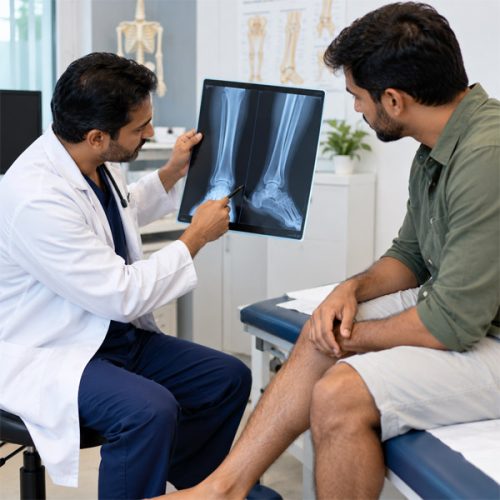
An evaluation begins with the original injury and treatment history. Your surgeon will examine the limb, ask where the pain occurs and review the course of your recovery. Comparing earlier and current X-rays helps show whether new bone has formed across the break.
Depending on the fracture, a CT scan or another imaging test may be needed to see the healing area more clearly. Blood tests may be recommended if there is concern about infection or a health condition affecting bone healing. The next step follows the findings; a single scan does not determine treatment by itself.
For a broader explanation of initial injury care, see our guide to bone fracture treatment in Ahmedabad.
What Can You Do While Awaiting Assessment?
Keep your follow-up appointments and follow the weight-bearing or activity instructions given for your fracture. Share your full medication list and relevant conditions, including diabetes. If you use tobacco or nicotine, ask your doctor for help stopping; nicotine can impair bone healing. Eat a balanced diet, and take supplements only if your clinician recommends them for a specific need.
Avoid testing the bone by increasing activity because you feel a little better. The amount of weight or exercise that is safe depends on the fracture and its current stability.
FAQ's
Does pain after a fracture always mean the bone has not healed?
No. Pain can have several causes, including stiffness or surrounding soft-tissue problems. Persistent pain at the break, especially with limited progress on follow-up imaging, is a reason to ask for an orthopedic review.
Can a nonunion heal without another operation?
Some cases can be treated without surgery, while others require better stability, a graft, infection treatment or a combination of approaches. A surgeon needs to identify the cause before recommending a plan.
Do I need a new X-ray if I already had one?
Earlier images are valuable because they let the surgeon compare changes over time. New X-rays or additional scans may be advised based on your symptoms and the quality and date of the available images.
When should I ask for a second opinion?
Consider a second opinion if healing has stalled, the reason is unclear, or you want to understand the benefits and risks of another procedure. Bring your previous scans and treatment records to make the consultation useful.
Get a Fracture Healing Assessment in Ahmedabad
If a fracture still hurts or you have been told it is healing slowly, an individual evaluation can clarify the next step. Dr. Mitul Patel sees patients for trauma and fracture care in Paldi and Science City, Ahmedabad. Book an appointment and bring your earlier reports and images.
This article is general information. Your diagnosis and treatment depend on an examination and your own imaging and medical history.