
ACL Tear Surgery vs Physiotherapy Which Treatment Is Right for You
ACL Tear: Surgery vs Physiotherapy
A sudden knee twist, a loud popping sound, rapid swelling, or the feeling of your knee giving way can be a frightening experience. For athletes, active individuals, or anyone who has suffered a sudden knee injury, finding the right ACL tear treatment in Ahmedabad is the first step towards getting back to a pain-free, active life.
The Anterior Cruciate Ligament (ACL) is vital for knee stability, but not every injury is identical. The most common dilemma patients face is whether to choose structured physiotherapy or opt for ACL reconstruction surgery.
The correct choice depends on your knee stability, associated injuries, daily activity level, and personal goals. Exploring these options with a qualified orthopedic specialist will help you make an informed, confident decision without rushing.
Quick Answer: Does every ACL tear need surgery?
No, not every ACL tear requires surgery. The ideal treatment is highly individual. While active athletes with complete tears and severe knee instability often need surgical reconstruction to return to pivoting sports, many partial tears or patients with lower-demand activities can recover successfully using a structured, supervised physiotherapy programme. Your doctor will evaluate your specific stability, activity goals, and associated knee damage.
What Is an ACL Tear?
The ACL, or Anterior Cruciate Ligament, is a strong band of tissue located deep inside your knee joint. It connects your thigh bone (femur) to your shin bone (tibia). Its primary job is to control knee stability, specifically preventing the shin bone from sliding too far forward and controlling rotational movements.
When the knee is forced beyond its normal range of motion—especially during cutting or twisting movements—the ligament stretches and can tear. This injury can range from a mild sprain (where the ligament is stretched but intact) to a partial tear or a complete rupture.
Ligament | Location | Main Function | Common Injury Mechanism |
ACL (Anterior Cruciate Ligament) | Centre of the knee | Prevents tibia from sliding forward; provides rotational stability. | Sudden twisting, pivoting, or sudden deceleration. |
PCL (Posterior Cruciate Ligament) | Back of the knee | Prevents the tibia from sliding backward. | Direct impact to the front of a bent knee (e.g., dashboard injury). |
MCL (Medial Collateral Ligament) | Inner side of the knee | Prevents the knee from bending inward. | Direct blow to the outer side of the knee. |
Common ACL Tear Symptoms
An ACL injury is usually highly noticeable when it happens. However, the initial shock can sometimes mask the exact symptoms.
- A loud popping sound or sensation in the knee
- Sudden, severe pain
- Rapid swelling within the first 2-24 hours
- Difficulty putting full weight on the injured leg
- Reduced movement and stiffness
- The knee “giving way” or buckling
- Instability while turning or pivoting
- Difficulty returning to your sport or activity
Symptom | What It May Indicate | Recommended Action |
“Pop” sound + immediate swelling | High likelihood of a torn ACL or broken blood vessel inside the joint. | Stop activity immediately, apply ice, and seek medical attention. |
Knee giving way while walking | Significant knee instability; the ACL is no longer securing the joint. | Use crutches or a knee brace to prevent falls until examined. |
Locking or catching sensation | Possible associated meniscus damage or loose cartilage fragment. | Avoid forcing the knee straight; consult an orthopedic specialist. |
How Do ACL Injuries Happen?
Most ACL tears are non-contact injuries, meaning they happen without anyone else touching you. They occur when the biomechanical limits of the knee are exceeded. Common causes include a sudden direction change, an awkward landing from a jump, or sudden stopping while running.
Activities That Commonly Place Stress on the ACL:
- Pivoting sports like football, kabaddi, basketball, and badminton
- Activities requiring sudden deceleration, like tennis or squash
- Road traffic accidents, especially two-wheeler skids
- Direct impact or trauma to the side or front of the knee
- Work-related injuries involving heavy lifting and sudden turns on uneven ground
Partial vs Complete ACL Tear
Understanding the extent of your injury is crucial for planning your treatment.
Factor | Partial ACL Tear | Complete ACL Tear |
Ligament Damage | Only a portion of the ligament fibres are torn. | The ligament is completely snapped into two pieces. |
Knee Stability | Usually remains somewhat stable; may feel slightly loose. | Clinically unstable; prone to buckling or giving way. |
Typical Symptoms | Pain, mild to moderate swelling, stiffness. | “Pop” sound, rapid swelling, severe instability. |
Associated Injuries | Less common, but still possible. | High risk of associated meniscus or cartilage tears. |
General Treatment Direction | Often responds well to non-surgical treatment. | Often requires surgery for active individuals. |
Need for Rehabilitation | Essential to strengthen supporting muscles. | Essential, whether treated with or without surgery. |
Possible Surgical Consideration | Rarely needed unless instability persists. | Strongly considered for athletes or active adults. |
How Is an ACL Tear Diagnosed?
A correct diagnosis requires a combination of your injury history, a physical examination, and advanced imaging.
Your doctor will perform specific physical tests, such as the Lachman test, Anterior drawer test, and Pivot shift test, to physically check the laxity (looseness) of your knee. While an MRI is excellent for visualising soft tissues, the final treatment decision should not depend only on an MRI report; clinical symptoms matter just as much.
Test | What It Evaluates | Why It Is Used |
Lachman Test | Forward movement of the tibia. | Considered the most sensitive physical test for diagnosing an ACL tear. |
Pivot Shift Test | Rotational stability of the knee. | Replicates the “giving way” feeling to assess the need for surgery. |
X-ray | Bones of the knee joint. | To rule out fractures or bone-related injuries (does not show ligaments). |
MRI Scan | Ligaments, meniscus, and cartilage. | Provides a detailed internal picture to assess the severity and check for associated joint damage. |
Patient Situations: Problem and Solution
Patient Situation | Possible Treatment Direction | Why Evaluation Is Needed |
Partial tear with a stable knee | Structured Physiotherapy | To confirm stability and begin safe muscle strengthening. |
Complete tear with low activity level | Physiotherapy & Bracing | Surgery may be avoided if the patient avoids pivoting activities. |
Complete tear in an athlete | ACL Reconstruction Surgery | High-demand sports require a mechanically stable knee to prevent further damage. |
ACL tear with meniscus injury | Surgery (often combining both repairs) | A torn meniscus can worsen joint wear and often needs surgical fixing alongside the ACL. |
Repeated knee giving way during walking | Surgical Evaluation | Chronic instability risks severe cartilage damage over time. |
Patient improving well with physiotherapy | Continued Non-Surgical Care | If the knee feels stable and goals are met, surgery may not be necessary. |
When Can an ACL Tear Be Treated With Physiotherapy?
Non-surgical ACL physiotherapy treatment is a highly effective route for many patients. It is generally recommended for patients who have partial tears with good stability, participate in lower-demand activities (like jogging or cycling), or are willing to modify their activities. It is also the preferred route for patients who have not experienced repeated knee giving-way episodes, or those who are medically unfit for surgery.
Goals of a Structured Physiotherapy Programme:
- Reduce pain and joint swelling
- Restore full knee movement (bending and straightening)
- Strengthen the quadriceps and hamstrings to support the joint
- Improve balance and proprioception (joint awareness)
- Improve overall knee control during daily movements
- Build patient confidence
When May ACL Reconstruction Surgery Be Recommended?
Surgery is often the safest path to return to high-level physical activity. It may be recommended if you experience repeated knee instability, have a complete ACL tear and wish to return to pivoting sports, or work in a physically demanding occupation.
Additionally, if you have an associated meniscus or cartilage injury, or multiple knee ligament injuries, surgery is usually required to prevent long-term joint degradation. Surgery is also considered if you experience continued instability even after completing a structured rehabilitation programme.
ACL Surgery vs Physiotherapy Comparison
Factor | ACL Surgery With Rehabilitation | Physiotherapy Without Surgery |
Main Goal | Rebuild the ligament to restore mechanical stability. | Train surrounding muscles to compensate for the torn ACL. |
Suitable Patient | Athletes, active adults, those with unstable knees. | Sedentary adults, those with partial tears, or no instability. |
Knee Stability | Restores native joint mechanics and stability. | Relies on dynamic muscle control for stability. |
Activity Level | High (football, cricket, heavy manual labour). | Low to Moderate (walking, swimming, cycling, gym). |
Associated Injuries | Can repair meniscus and cartilage simultaneously. | Cannot mechanically fix a severely torn meniscus. |
Recovery Commitment | 6 to 9+ months of intensive rehabilitation. | 3 to 6 months of focused strengthening. |
Return to Pivoting Sport | Highly likely, following successful rehab. | Less likely; carries a higher risk of the knee giving way. |
Possible Limitations | Surgical risks, stiffness, graft failure risk. | Knee may still buckle during unexpected sudden movements. |
What Happens During ACL Reconstruction Surgery?
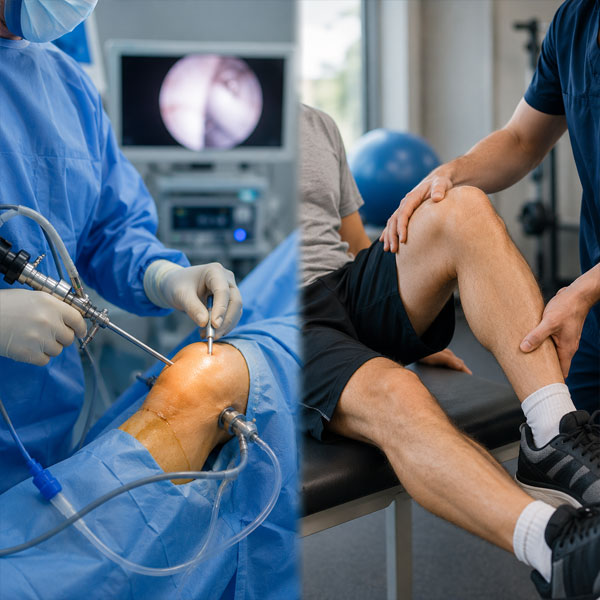
Because a completely torn ACL cannot be stitched back together, doctors perform an ACL reconstruction surgery. This is done using an arthroscopic or “keyhole” approach.
The surgeon removes the damaged ACL and replaces it with a substitute piece of tendon, known as a graft. This graft is passed through bone tunnels drilled into your femur and tibia and fixed in place using specialized screws or buttons. During the same procedure, the surgeon will evaluate and treat any associated meniscus damage. Rehabilitation begins almost immediately after surgery to ensure the new graft heals properly while joint mobility is maintained.
Graft Type | Source | Possible Advantages | Important Considerations |
Hamstring Tendon | Back of the patient’s thigh. | Smaller incision, less front-knee pain. | May slightly reduce hamstring strength. |
Patellar Tendon | Front of the patient’s knee (bone-tendon-bone). | Very strong fixation, historically popular for elite athletes. | Higher risk of kneeling pain post-surgery. |
Quadriceps Tendon | Tendon above the kneecap. | Thick and robust graft material. | Requires specific rehabilitation for the quad muscle. |
Patient Problem and Recommended Action
Recovery Phase | Main Goal | Typical Activities | Progress Checks |
Weeks 1-4: Early Phase | Reduce swelling, regain full knee straightening. | Gentle bending, walking with crutches, quad sets. | Full knee extension, minimal joint swelling. |
Weeks 4-12: Strength Phase | Build muscle mass and normalise walking. | Squats, leg presses, balance exercises, stationary cycling. | Normal walking pattern, improved quad strength. |
Months 3-5: Control Phase | Improve joint control and endurance. | Light jogging (if cleared), agility drills, jumping basics. | Hop tests, strength symmetry between legs. |
Months 6-9+: Sport Prep Phase | Safely return to high-demand activities. | Sport-specific drills, cutting, pivoting, match-play simulation. | Passing strict return-to-sport functional testing. |
Risks of Ignoring an Unstable ACL Tear
If you have a complete ACL tear that causes knee instability, ignoring it can lead to secondary complications. Repeated giving-way episodes can severely reduce your confidence during daily activities.
More importantly, every time the knee buckles, the bones shift unnaturally, placing massive stress on the meniscus and the smooth cartilage lining the joint. Over time, untreated instability can lead to complex meniscus tears and premature joint wear. This limits your participation in sports or demanding work. While not every untreated ACL tear causes severe arthritis, chronic instability significantly increases the risk.
Questions to Ask Before Choosing ACL Surgery or Physiotherapy
Before finalizing your treatment plan, discuss these questions with your sports injury doctor in Ahmedabad:
- Is my tear partial or complete?
- Is my knee clinically unstable during physical tests?
- Is the meniscus or any other ligament also injured?
- Can I safely return to my desired sport or job without surgery?
- What happens if I delay surgery for a few months?
- What are the specific goals of my physiotherapy plan?
- How will my recovery and muscle progress be measured?
- If surgery is needed, which graft type may be most suitable for me?
- What are the potential treatment risks for both options?
- When can I realistically expect to return to work, driving, or sports?
FAQ's
Can an ACL tear heal without surgery?
A completely torn ACL generally cannot heal on its own because the synovial fluid inside the knee joint prevents blood clots from forming to bridge the gap. However, some partial tears can heal with proper rest. Many patients achieve excellent knee stability and return to daily activities through structured physiotherapy without needing surgery.
Does every complete ACL tear require surgery?
No, not every complete tear needs surgery. If you have a sedentary lifestyle, participate only in low-impact activities like swimming or cycling, and do not experience your knee giving way, physiotherapy may be sufficient. Surgery is primarily recommended for athletes, young adults, or those with physically demanding jobs requiring knee stability.
Can I walk with a torn ACL?
Yes, most people can walk with a torn ACL once the initial pain and swelling subside. The ACL is crucial for rotational stability and pivoting, not straightforward walking. However, walking on an unstable knee without medical guidance can risk further injury to the meniscus if the joint unexpectedly buckles.
How can I know whether my ACL tear is partial or complete?
While symptoms provide clues, a clinical examination by an orthopedic doctor is required. Tests like the Lachman and Pivot shift test assess joint looseness. An MRI is then used to visually confirm the extent of the ligament damage, distinguishing between a sprain, a partial tear, and a complete rupture.
Is an MRI necessary for an ACL injury?
While a skilled doctor can diagnose an ACL tear through a physical exam, an MRI is highly recommended. It confirms the diagnosis, identifies if the tear is partial or complete, and crucially checks for hidden damage to the meniscus, cartilage, and other ligaments, which heavily influences the final treatment plan.
What happens if an ACL tear is not treated?
If left untreated, an unstable knee can repeatedly give way during physical activity. These constant micro-traumas can severely damage the meniscus and joint cartilage. Over time, this drastically increases the risk of early-onset osteoarthritis and limits your ability to participate in sports or perform demanding physical tasks safely.
How long does ACL physiotherapy take?
For patients choosing non-surgical treatment, a focused physiotherapy programme typically takes 3 to 6 months to build sufficient muscle compensation. For those undergoing surgery, post-operative rehabilitation is longer and more intense, usually taking 6 to 9 months or more to safely prepare the knee for a return to sports.
When can I return to sports after ACL reconstruction?
Returning to pivoting sports usually takes 9 to 12 months after surgery. However, timelines vary based on individual healing and effort. You should only return to sports when cleared by your surgeon and physiotherapist after passing strict functional strength, balance, and agility tests, ensuring both legs have symmetrical power.
What factors affect ACL surgery cost in Ahmedabad?
The total cost depends on the type of hospital, the surgeon’s experience, and whether any meniscus repair is done simultaneously. The choice of implants (such as titanium versus bio-absorbable screws for graft fixation) and the duration of your required post-operative physiotherapy also significantly influence the overall financial investment.
Where can I consult for ACL tear treatment in Ahmedabad?
You should consult a dedicated orthopedic sports injury specialist with experience in knee arthroscopy. Clinics equipped with advanced diagnostic and rehabilitation facilities offer the best outcomes. Dr. Mitul Patel provides comprehensive clinical evaluations and personalized treatment plans for patients across Ahmedabad, helping them restore knee function safely.
Conclusion
Choosing between surgery and physiotherapy is a major decision, and neither path is automatically correct for everyone. The best ACL tear treatment in Ahmedabad relies on a thorough clinical examination and a detailed MRI review to understand your specific injury pattern. Whether you visit a clinic in Paldi or consult a specialist near Science City, personalised care is essential for restoring your knee stability.
An experienced orthopedic sports injury doctor will guide you through structured rehabilitation or surgical options based on your unique goals. While a full return to high-impact sports requires dedication and time, the right treatment plan sets the foundation for a safer, stronger recovery. Contact us today to book a consultation, evaluate your knee, and discuss the most appropriate treatment for your active future.